
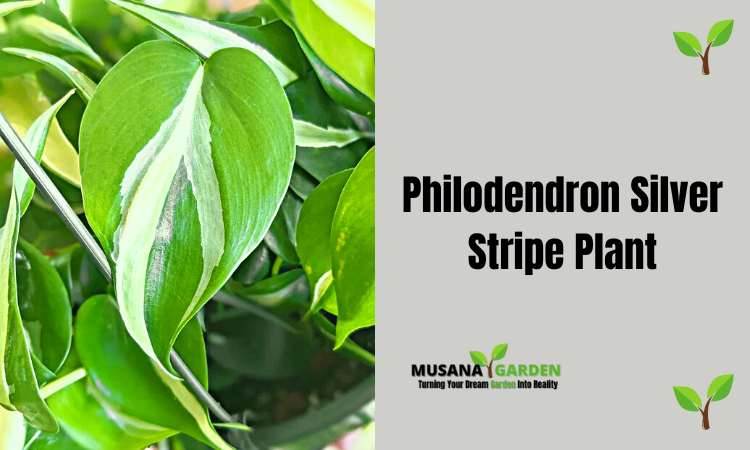
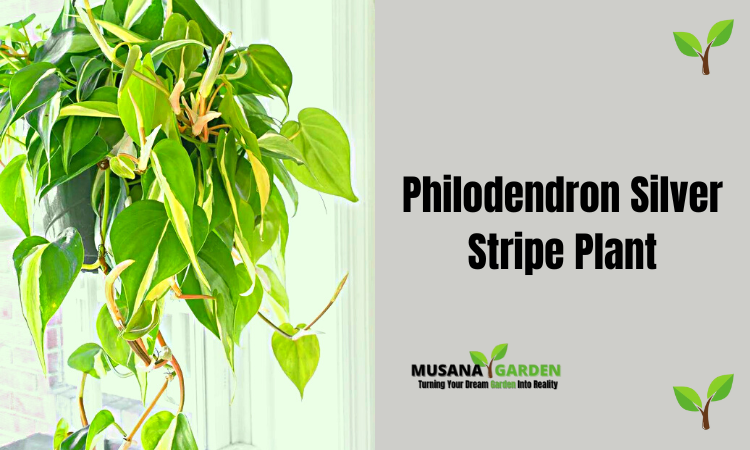
It is a creeper or trailing plant that is generally known as the Heartleaf philodendron or the Sweetheart vine. Philodendron silver stripe is one of the many names for this species. The heart-shaped, lush leaves of this plant, which are typically around three inches in size and have a pointed end, are where the plant got its name.
The moniker “silver stripe” refers to the sophisticated white stroke that runs through the middle of the leaf. In the following paragraphs, you will learn everything you need to know to properly care for and multiply this lovely plant.
What exactly is a silver stripe philodendron?
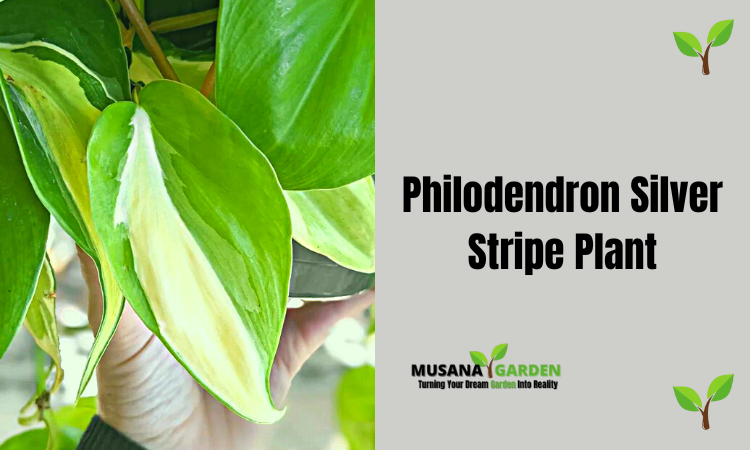
The Philodendron silver stripe is a variety of variegated Philodendron hederaceum that is distinct from its Brazilian counterpart. Variegation can be found in Brazil and ranges from yellow to lime green, with dark green serving as a border.
The hederaceum plant underwent a sport variegation, also known as a genetic mutation, which resulted in the appearance of silver stripes. Before the leaf acquires a dark green colour, the silver stipe has a greyish-silver stripe that runs down its margin. In addition, the silver stripe features yellow-green variegation.
Is there a difference between a cream splash and a silver stripe?
It would appear that the variation on a silver stripe is quite consistent throughout time. On the other hand, the plant may continue to mutate and end up producing cream as well. Because of this, it is sometimes difficult to tell it apart from another type called the cream splash.
A second factor that contributes to this misconception is the fact that extremely varied silver stripes are occasionally presented as cream splashes. On the other hand, they are not the same… or perhaps they are already?! Because I was unable to locate any evidence to support the argument that cream splashes belong to a distinct plant species. In other words, I am unable to determine the origin of the cream splash.
It would appear that plants known as “cream splash” have lime green, yellow, and dark green colours, but rather than having a silvery variation, they have more of a cream colouration. More to come I suppose… Please let me know if you come across any other information or sources of information.
Philodendron Silver Stripe Caring Tips

Philodendrons with heartleaf leaves are among the easiest of all tropical plants to cultivate successfully inside. They can withstand and forgive a certain amount of neglect, such as placing them in dim light, providing them with inadequate soil, and watering them a bit later than usual. People who are just starting with gardening or who just do not have the time to care for more finicky plants may find success with this plant.
Poisonousness
Both people and their pets should avoid coming into contact with the leaves of silver-stripe Philodendron. If consumed, one may experience swelling of the lips and mouth, discomfort in the stomach, nausea, and maybe vomiting.
Pruning
Your Philodendron silver stripe may require occasional trimming to remove any leaves that are sick, damaged, or discoloured. To prevent getting an infection, use scissors that have been sanitized. In addition, you can occasionally wash the leaves to maintain them clean.
Lighting Requirements
The Philodendron silver stripe can adapt to settings with little available light. When exposed to bright indirect sunlight, it will grow more quickly and generate larger leaves. If you want to see the variegation more clearly, you should move it somewhere with more light; however, you should not move it into direct sunlight because the foliage will be damaged.
A sunny window that also receives indirect light is often the ideal location for growing a potted Philodendron silver stripe. It is important to keep in mind that in its native environment, it grows beneath the shade of trees, and it was not intended to be grown in direct sunlight. On the other side, its growth can be stunted if it is exposed to very little light over extended periods. In the absence of light, it will not flourish.
Watering Requirements
The greatest way to ensure that this plant thrives is to ensure that you do not overwater it. The topsoil should be allowed to dry out between 50 and 70 per cent before applying any additional water to a Philodendron silver stripe plant. Don’t stop adding water until you notice water dripping out of the bottom of the pot, and make sure the pan that’s sitting underneath the pot stays dry at all times.
Water the plant less frequently during the winter months because that is the time of year when it should be dormant. Take care not to saturate the plant with water. It can induce root decay, which will ultimately result in the death of your Philodendron.
Humidity
Standard levels of humidity within the house are fine for the Philodendron silver stripe plant, but higher levels of humidity foster the growth of more lush foliage. The occasional application of mist is also beneficial to plants. The humidity around your plants can be increased in a few different methods, including the following:
- Install a humidifier
- Use a mister
- Keep plants together
- Wash leaves occasionally
Temperature
The Philodendron silver stripe is a tropical plant that enjoys having a warm, humid environment. It grows best in temperatures from 70 to 80 degrees Fahrenheit. Be aware that its development will be negatively impacted by temperatures that are lower than 55 degrees Fahrenheit.
Soil
The Philodendron silver stripe is an example of a hemiepiphyte, which refers to a plant that can thrive while attached to another tree. Because of this, the soil must have good drainage, the ability to hold moisture, and a high concentration of organic matter. You can either acquire soil mix for pots that have already been prepared or you can manufacture your soil mix.
Try your hand at cooking with this recipe: To get optimal drainage, combine moss, coconut coir, and perlite in a ratio of 50:50. To facilitate drainage, use a container that is equipped with a generous number of drainage holes.
Fertilizer
Silver Stripe Philodendron is known for its rapid growth in warmer environments or temperatures. It will flourish brilliantly if the appropriate amount of plant food is given to it. If you want the greatest outcomes, follow these tips:
Applying fertilizer twice or thrice during the growing season of the plant (spring and summer), which is spring and summer, will boost the growth rate of the Philodendron silver stripe.
Avoid applying fertilizer during the winter months.
Alternatively, the feed that is going to be utilized with each watering should be greatly diluted.
The following are some natural substances that can be used as plant feeding or fertilizer:
- Worm casting
- Fish emulsion
- Compost
- Manure
worms Castings have no smell but are quite expensive. Fish emulsions have a pungent odour, but they lose their offensive quality after they are diluted, and they are an exceptionally useful fertilizer. Because compost and manure can be highly potent, it is important to avoid over-fertilizing your plants with these substances.
Fertilizers that have a slow release help the plants to take in the nutrients more gradually, which makes things easier for the gardener. Each time you water, you should use some liquid fertilizer that has been diluted with water. Throughout the growing season, a constant supply of nutrients is made available to the plants.
Potting
The Philodendron silver stripe does very well when grown in a container. When you are thinking about re-potting your lovely plants, bear the following considerations in mind:
Pick a container that has several holes for drainage, particularly one that is made of terracotta or ceramic.
If the soil in your garden has good drainage, plastic containers are another option.
When the plant has outgrown its current container, it is time to upgrade to a larger pot.
It is best to perform transplants in the evening.
More Guide
- Philodendron dark lord vs majesty Comparison
- Philodendron Fuzzy Petiole Vs Nangaritense Guide
- Philodendron Melanochrysum Vs Micans Guide
- Philodendron Plowmanii Vs Mamei best comparison Guide
- Philodendron Pedatum Vs Florida Guide
- Philodendron Red Sun Vs Prince Of Orange
- Philodendron Orange Marmalade
- Philodendron Imperial Green
- Philodendron Paraiso Verde Guide
- Philodendron Golden Dragon Guide
- Philodendron Florida Green Guide
Propagation
The beginning of summer and the end of summer are the finest times to propagate the Philodendron silver stripe. For cuttings to develop roots, warm conditions are required. Two different methods can be used to multiply Philodendron silver stripe plants.
- Air layering
- Stem cutting
In this section, we are going to examine each approach in further depth and provide you with easy-to-follow step-by-step instructions.
Air Layering
The use of air layering is the most effective method for the propagation of Philodendron silver stripe. If you are interested in utilizing this strategy, the following is a simple guide that you can follow:
- Choose a healthy stem that is strong and has more than two nodes.
- Wrap a node in peat moss and then in plastic.
- Tie the peat moss to the stem to keep it in place.
- Leave it there for a few weeks, until you see roots growing inside the plastic wrap.
- Just below the wrap, make a clean cut.
- You now have a single plant that can live and grow on its own.
- Take off the plastic and plant the cutting in the right kind of potting mix.
- Protect it for a few weeks so it can get stronger.
Stem Cuttings
During the summer months, there is a second method for propagating the stems. It is possible to take stem cuttings and reproduce the plant using the process of water propagation. You will require the following items for this method:
- One pair of clean scissors
- Few healthy branches with two nodes
- A bottle or jar full of clean water
The steps that you need to take are quite easy to understand:
- Cut carefully with scissors that have been cleaned.
- Remove the leaves at the bottom.
- Make sure 3 to 4 inches of the bottom of the stem are submerged in water.
- Leave it in this container for a few days, until you see roots growing.
- Keep switching out the water often.
- Once you can see the roots, you can move the plant to a new pot and let it grow there.
You will no longer have any trouble expanding your plant collection or rescuing a plant if you make use of these propagation instructions. We hope that this straightforward instruction was able to answer any questions you had about propagation, which is an excellent method for increasing the number of plants you have.
Is the Rio philodendron the same as the silver stripe philodendron?
Last but not least, let’s talk about the philodendron Rio, which looks a lot like a silver stripe. There are also silver, cream-coloured yellow, and dark green leaves on the Rio variety. But only the Rio has silver in the middle, and it’s the only kind.
Rio’s weather is also very stable. The grower Gabriella Plants came up with the philodendron Rio in 2009, so you can thank them for this beautiful variety. This beautiful art print by Aaron Apsley also shows the different shades of colour.
Problems
In most cases, the Philodendron silver stripe is a problem-free plant; nonetheless, it may occasionally exhibit indications of distress or disease, the majority of which are caused by improper treatment. It is a plant that is resistant to pests, and if you follow the steps on a symptom checker, you will be able to troubleshoot any issues as they arise.
The following is a list of potential issues that could arise with your plant:
- Leggy Stems
When there is not enough strong indirect bright light, Philodendron silver stripe plants will develop spindly stems. You can try moving the plant to a brighter spot, but if it already appears to be sick, you should just take some cuttings and start over. If you pinch back the new growth on the plants, they will get bushier.
- A Halting of the Leaf Development
If the plant has few leaves or its leaf growth is restricted, it may require a stake to support itself. Canes made of bamboo or poles made of moss provide support for plant growth and assist the development of larger leaves.
- Uneven or Aberrant Development
Sometimes only one side of the Philodendron silver stripe plant will sprout leaves, giving the impression that the pot is empty. You can allow a stem that has been clipped on the side of the pot that is empty to root by doing so. A new stem is going to grow from there, which will make the container appear to be fuller.
- Vegetation With Discolored Leaves
Leaves that have reached their maturity gradually lose their lustre and fall off. A sign that the plant is suffering from stress is when its young leaves begin to lose their vibrant colour. This occurs when there is insufficient light; to remedy the situation, relocate the plant to an area that receives bright indirect light.
- The Complete Lack of Variation
The features of this plant are the silvery strokes and variegation that it possesses. Take note that in conditions of extremely low light, the leaf becomes greener and loses its variegation. This issue can be remedied by relocating the plant to an area that receives an abundant amount of light.
- Leaves That Are Yellow
If the root rots, the leaves of the Philodendron silver stripe may begin to become more brittle. This takes place as a result of overwatering, which leads to the decomposition of the roots. Remove the plant and then fill in the hole with new soil. If the issue has become more severe, you always have the option of taking cuttings and starting over.
Keep the soil moist by monitoring how quickly it dries out and acting accordingly. Before providing more irrigation, the soil should have a moisture content of between 50 and 70 per cent.
Encouraging fullness in a silver stripe
In addition to giving your plant the right amount of light, water, soil, temperature, and humidity, pruning is the best way to make it grow fuller. It can be scary to cut your plants, but I do it all the time. It helps new growth be full and healthy.
Pruning is another great way to help your plant get back on its feet after it has grown too tall. You can just cut off the parts that are too long, whether it was because of the cold or because you were in a dark room. The growth point just above where you cut will send out new shoots.
Frequently Asked Question

What is a Silver Stripe Philodendron?
Philodendron Silver Stripe is a type of indoor plant whose leaves are known for their pretty silver stripes. It comes from the Philodendron family, which is known for plants that are easy to grow and require little care.
How do I take care of a Silver Stripe Philodendron?
Here’s how to take care of a Philodendron Silver Stripe:
- Put the plant somewhere that gets bright light from the side. Keep the leaves out of direct sunlight, which can make them turn yellow or burn.
- Water the plant regularly so that the soil is always moist but not soggy. Before you water again, let the top inch of soil dry out.
- Use potting mix made for indoor plants that drain well.
- During the growing season, give the plant a balanced liquid fertilizer once a month.
- Place the plant somewhere where the temperature is between 60°F and 80°F (15°C and 27°C). Don’t put it somewhere that is drafty or cold.
- Mist the plant or put the pot on a tray filled with water and pebbles. This will make the air around the plant more humid.
- Cut the plant back as needed to keep its shape and get rid of any leaves that are damaged or sick.
How big will a Silver Stripe Philodendron get?
When grown inside, Philodendron Silver Stripe plants can get up to 3–4 feet tall and wide.
Can pets get sick from a Philodendron Silver Stripe?
Pets should not eat Philodendron plants, including Philodendron Silver Stripe. Poisoning in pets can cause them to vomit, have diarrhoea, and have trouble breathing. Keep Philodendron plants out of reach of your pets to keep them safe. You could also use a plant screen or something else to keep your pets away from the plant.
Can a Silver Stripe Philodendron be grown outside?
Philodendron Silver Stripe is usually grown indoors, but in warm, humid climates, it can also be grown outside. If you live in a colder area, you should grow it in a greenhouse or bring it inside for the winter.
Conclusion
Philodendron silver stripe is a beautiful form of the species that does well in a pot. It’s easy to grow, so it’s a good choice for people who have never grown a plant before. The full care guide, which you can read above, talked about the following:
- Philodendron silver stripe does well as a house plant in a pot when it gets indirect bright light.
- It is easy to grow and is known for the white or silvery lines in the middle of its leaves.
- This tropical plant needs soil with good drainage.
- Philodendron silver stripe grows best in a mix of peat moss, perlite, and coir.
- During the growing season, the Philodendron silver stripe needs good plant food, but too much fertilizer can hurt it. Don’t add fertilizer in the winter.
- Philodendron silver stripe plants do best in temperatures between 70 and 80 degrees Fahrenheit, and frost can hurt them.
- It is bad for its health to water it too much. Only water the plants when the soil is dry.
- During the summer, use a humidifier or mist your plants.
- When the Philodendron silver stripe is staked, its leaves will get bigger.
- It can be spread by air layering from early to late summer.
- Philodendron silver stripe may show signs of weakness, which are usually the result of not taking good care of the plant.
- Too much watering causes root rot, which can be fixed by changing the potting soil.
Philodendron silver stripe is poisonous and should not be near kids or animals.
Philodendron silver stripe is a beautiful plant that should be in every home garden. The silvery lines on its green leaves look like a piece of art, and now that you know how to take care of it, you should go ahead and get one for yourself.
Check Out This Trending Guide Below
- Philodendron Strawberry Shake plant Guide
- philodendron painted lady plant Guide
- Philodendron Ring of Fire Plant Guide
- Philodendron Blizzard Plant Guide
- Philodendron Golden Violin Guide
- Philodendron Ceylon Beauty Guide
- Philodendron Golden Crocodile Guide
- Philodendron Whipple Way Guide
- Philodendron Caramel Marble vs Ring of Fire Guide
- Philodendron Fuzzy Petiole Guide
- Philodendron Jose Buono Care Guide
- Philodendron el choco red Guide