
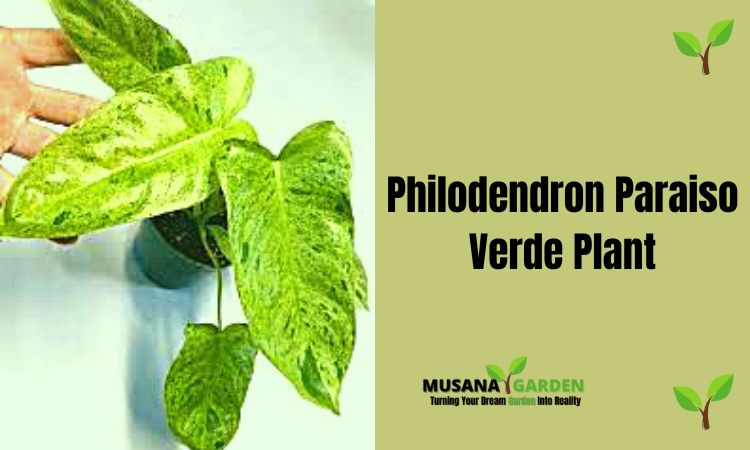
If you have ever seen a Philodendron Paraiso Verde, then you have some idea of how stunningly beautiful this uncommon indoor plant can be.
This highly desirable tropical plant has leaves that are shaped like an elongated heart and come in a variety of colours that will simply astound you.
Even though it is a relatively uncommon houseplant, caring for a Philodendron Paraiso Verde is not nearly as challenging as you might imagine.
It does require special care, but providing that care is not at all difficult, and this care guide will assist you in doing so.
It’s possible that the Philodendron Paraiso will be difficult to find. However, if you do manage to locate one, it will be well worth your time.
In addition to that, it will look absolutely stunning among the other plants in your collection.
What Exactly Is This Philodendron Paraiso Verde?
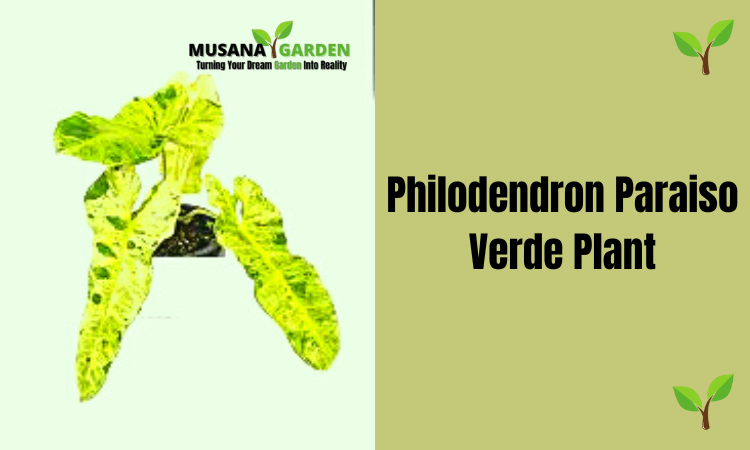
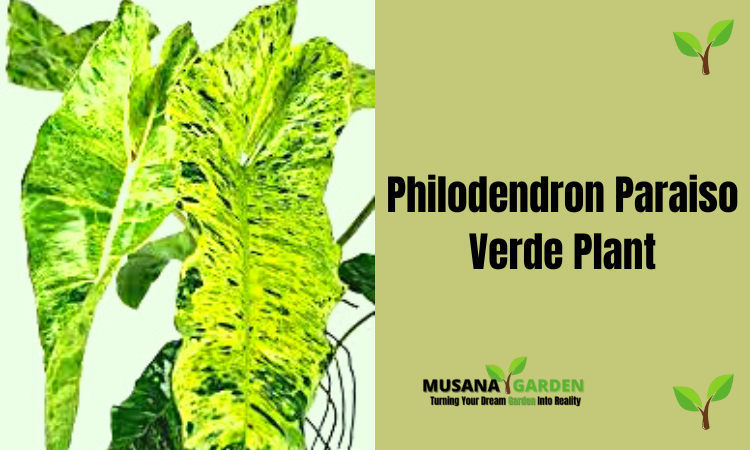
Philodendron Paraiso Verde, also known as Green Paradise, has leaves that are elongated and can be either light or dark green in colour, and they have beautiful mottled variegations. In addition to that, it is sometimes referred to by the name Marina Ruy Barbosa, which is derived from the name of a lovely young Brazilian actress.
It is an item that is considered to be valuable among collectors because of how uncommon it is. It is frequently reported to be “out of stock,” and it is almost always sold at a premium price, despite the fact that it is available for purchase all over the Internet.
Philodendron Paraiso Verde Care – Quick Guide
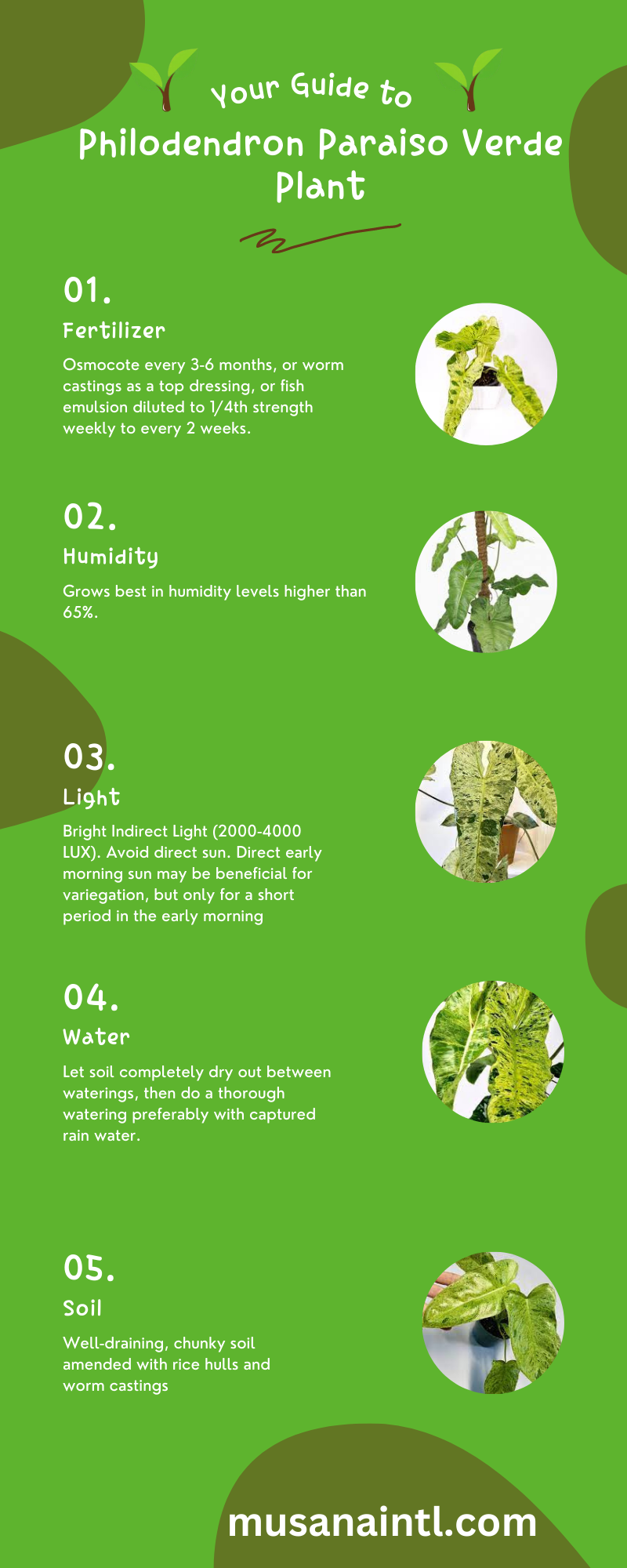
- A bright light that comes from behind you (2000-4000 LUX). Avoid direct sun. However, exposure to the sun in its direct form first thing in the morning is only likely to be beneficial for variegation for a brief window of time.
- The soil is well-draining, chunky soil that has been amended with worm castings and rice hulls.
- The best way to water your plants is to use rainwater that you have collected yourself after allowing the soil to become completely dry in between waterings.
- Optimal growth occurs at relative humidity levels greater than 65%.
- The temperature is quite warm. 65º – 85ºF / 17º – 29ºC. Steer clear of frost.
- Osmocote should be applied once every three to six months, worm castings can be used as a top dressing, and fish emulsion should be diluted to a quarter of its original strength once every week to twice a month.
Philodendron Paraiso Verde’s Unique Look
The elongated, narrow, heart-shaped leaves of the Paraiso Verde are likely the first thing that will catch your eye about the plant. These leaves also have a wavy texture.
These leaves grow to be quite lengthy. Some of them can reach a length of up to 10 inches. I believe you’ll agree with me when I say that each leaf has its own distinctive appearance.
The next thing that contributes to Paraiso Verde’s allure is its colouration and the variety of its terrain.
Some of the leaves have a deeper, more consistent green colour, while others are highly variegated with a wide range of green hues.
Variegation can appear as anything from fine lines to thick splotches and everything in between.
The amount of sunlight that reaches the plant is directly related to the variety of colouration that appears on its leaves.
A greater amount of indirect sunlight will lead to a greater amount of variegation. If the Paraiso Verde plant is brought inside during the winter, its new leaves will be more green overall, with only a hint of variegation.
Although the leaves are quite long, they are carried by relatively short stems.
This plant will require a rod or moss pole for support due to the fact that its leaves have the potential to grow to be quite large.
Because philodendrons love to climb, providing them with external support will also help your plant grow more quickly.
The Necessary Amount of Water
The Philodendron Paraiso Verde requires regular watering as an essential component of its care.
In general, the process of watering a Philodendron or any other type of aroid for the first time can be intimidating.
But if you want to give your Paraiso Verde the best chance of survival, you should wait until the soil has completely dried out before giving it any more water for the first time.
Even the most experienced plant parents can run into issues if they overwater their plants. The problem is that overwatering can kill plants.
Because of this, it is best to err on the side of caution and let the soil in your Paraiso Verde plant dry out in between waterings. This will help ensure that your plant thrives.
A moisture meter can be used to determine the amount of moisture in the soil.
You can also check for moisture by sticking your finger into the ground up to the second knuckle and feeling around for it. Wait to water until you feel even the slightest amount of moisture.
If you overwater your Paraiso Verde plant, it may develop a disease called root rot, which is harmful to the plant’s overall health.
As was previously mentioned, the best way to protect a plant from developing root rot is to use soil that drains well and a container that has plenty of drainage holes.
Rainwater that has been collected is the kind of water that is ideal for use in your Paraiso Verde.
If you do not have access to a rain barrel, the next best thing is to drink water that has been filtered.
But if you don’t mind using water from the tap, you should be fine.
The Most Effective Approach to Watering Your Paraiso Verde
Before you can water your Paraiso Verde plant, you must first remove the plant pot from the saucer or cache pot it was growing in.
The next step is to put it in a tub or outside. Basically anywhere that has holes or cracks in the ground that let water and some soil particles escape.
If you are going to water your plant in a tub, you need to make sure that you have a good drain strainer in order to prevent the drain from becoming clogged with bits of soil.
After that, give the plant a complete and extensive soaking by top-watering every inch of soil that is visible.
Apply an adequate amount of water to the soil so that a significant portion of it seeps through the soil and emerges from the bottom drainage holes.
Complete and extensive watering will not only help to remove any mineral or chemical buildup in the soil, but it will also ensure that water is distributed evenly across the area.
Light Requirements
Philodendron Paraiso Verde needs a lot of light, but not direct sun.
Paraiso Verde will keep its unique pattern as long as it gets a lot of indirect sunlight.
You might find that a tiny bit of direct morning sunlight is good for Paraiso Verde, especially for its color.
But keep in mind that it should only be sunlight from the early morning.
Never put it in the full sun.
In fact, the full sun could change the way your Paraiso Verde’s leaves look and even burn them.
So, this Philodendron would do best in a room that gets a lot of natural light and is well-lit.
If you put the plant near a window, make sure you have a sheer curtain to spread out the light that the plant will get.
If you put your Paraiso Verde outside, put it in the shade or under a shade cloth.
Temperature Requirements
Philodendron Paraiso Verde is a tropical plant, so it does best in temperatures between 65°F and 85°F/17°C and 29°C.
In terms of temperature, the most important thing is to make sure your Paraiso Verde doesn’t get frost or harsh temperature changes.
If you keep your Paraiso Verde outside, bring it inside when the temperature outside drops below 17oC or 65oF.
If you keep your Paraiso Verde indoors, keep it away from drafts from air conditioners, heaters, furnaces, and open windows.
Repotting
You might only have to repot your Paraiso Verde once or twice a year.
When the plant’s roots start to grow through the drainage holes in the pot, it’s time to re-pot it.
Spring is the best time to repot your plant.
Add 2 inches to the diameter of the pot, and don’t forget to use your chunky, well-draining aroid soil mix.
Check Out This Trending Guide Below
- Philodendron Strawberry Shake plant Guide
- philodendron painted lady plant Guide
- Philodendron Ring of Fire Plant Guide
- Philodendron Blizzard Plant Guide
- Philodendron Golden Violin Guide
- Philodendron Ceylon Beauty Guide
- Philodendron Golden Crocodile Guide
- Philodendron Whipple Way Guide
- Philodendron Caramel Marble vs Ring of Fire Guide
- Philodendron Fuzzy Petiole Guide
- Philodendron Jose Buono Care Guide
- Philodendron el choco red Guide
How Much Moisture Does Philodendron Paraiso Verde Need?
Philodendron Paraiso Verde grows in tropical forests, so it likes it when there is a lot of moisture in the air.
Try to give your Paraiso Verde a humidity level of 65% or more.
If you live in a damp area, your Philodendron will be very happy.
There are ways to give your Paraiso Verde enough humidity even if you don’t live in a humid area. This will keep it happy and healthy.
A humidifier is one way to raise the humidity of your plant indoors.
It is important to use an indoor humidifier the right way. Use distilled water and clean your humidifier often to stop mold from getting into the air.
You can also mist the leaves of your plant with distilled water to make the air around it more humid.
Be careful with this method, though, because if the leaves are always wet, your plant could get a fungal infection.
Putting your Philodendron on top of a tray of pebbles filled with water can also make the air around your plant more humid. As the water in the tray evaporates, the air around your plant will become more humid.
Last, you can put other plants that like humidity near a bowl of water to make the air around them more humid. Putting them together will also, in a way, trap the moist air around the leaves.
Fertilizing Your Paraiso Verde
It has been shown that Osmocote Smart-Release Plant Food Plus for outdoor and indoor plants helps Paraiso Verde grow very well.
It is a slow-release fertilizer that only needs to be used every 3 to 6 months during the Spring and Summer. Just follow the instructions on the package to put the Paraiso Verde on your plant.
Fish emulsion and worm castings are both natural ways to feed your Philodendron plants.
As a top dressing, sprinkle work castings over the soil.
You can water your plant every week or every two weeks with a fish emulsion that has been diluted to 1/4 of its original strength.
Other Important Tips for Caring for Philodendron Paraiso Verde
Moss Pole
In their natural home, the tropical rainforest, they would climb up tree trunks.
That’s why it’s important to give your Paraiso Verde a moss pole to climb on and hold on to.
If you want to make your own moss pole, we wrote a full guide.
Start by rolling some sphagnum moss that has already been wet into a PVC-coated wire mesh.
Roll up the mesh so it looks like a pole, and then tie it shut with wire twists that have been covered in plastic.
When it’s time to re-pot your plant, it’s best to add a moss pole.
You can add a couple of inches to the height of the pot and repot your plant using your new moss pole.
Put some wet sphagnum moss around the aerial roots of your Paraiso Verde to help them grow, and then tuck the moss into your moss pole.
Philodendron Paraiso Verde can have problems with pests if they don’t have a good place to live.
Pests
Pests like aphids, mealy bugs, spider mites, and scale are often a problem.
Check on your Paraiso Verde every time you water it and give it a once-over. This way, you can take care of any pest problems as soon as they come up.
If you have a problem with pests, put your Philodendron in a separate area and treat it with natural or store-bought insecticides.
If you have spider mites, this article will tell you how to get rid of them.
Toxicity
All Philodendrons have crystals of calcium oxalate, which can kill children and pets if they eat them.
Keep your plants away from small children and animals.
Conclusion
You should make every effort to add a Philodendron Paraiso Verde to your collection of plants because it is an extremely rare and desirable species of plant.
Follow the steps in this guide to ensure that your Philodendron Paraiso Verde remains healthy so that it can continue to provide you with years’ worth of pleasure. If you are one of the fortunate few who own this Philodendron, consider yourself among the lucky few.
More Guide
- Philodendron dark lord vs majesty Comparison
- Philodendron Fuzzy Petiole Vs Nangaritense Guide
- Philodendron Melanochrysum Vs Micans Guide
- Philodendron Plowmanii Vs Mamei best comparison Guide
- Philodendron Pedatum Vs Florida Guide
- Philodendron Red Sun Vs Prince Of Orange
- Philodendron Orange Marmalade
- Philodendron Imperial Green