
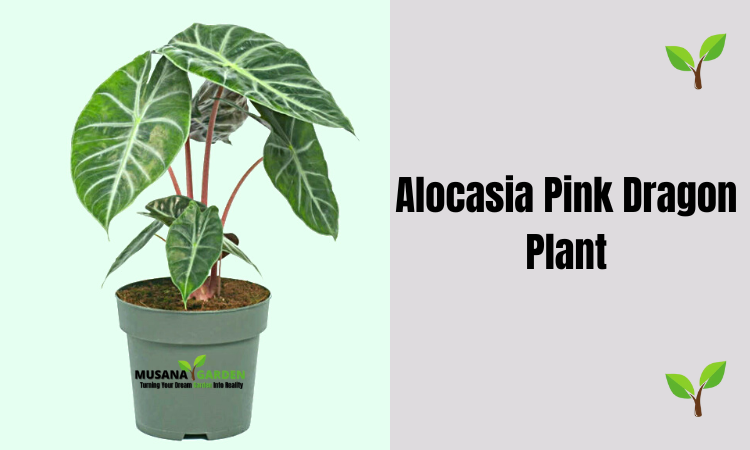
A tall, lush-potted Alocasia Pink Dragon will stand out more than anything else in your space.
This houseplant is about four feet tall, so it will not only be the centre of attention but will also give your living room a tropical jungle feel.
The best part is that it’s easy to take care of and doesn’t need much maintenance.
With a little care, this tropical plant will change your home in ways you couldn’t have imagined.
Where Alocasia Pink Dragon Came From and What It Is
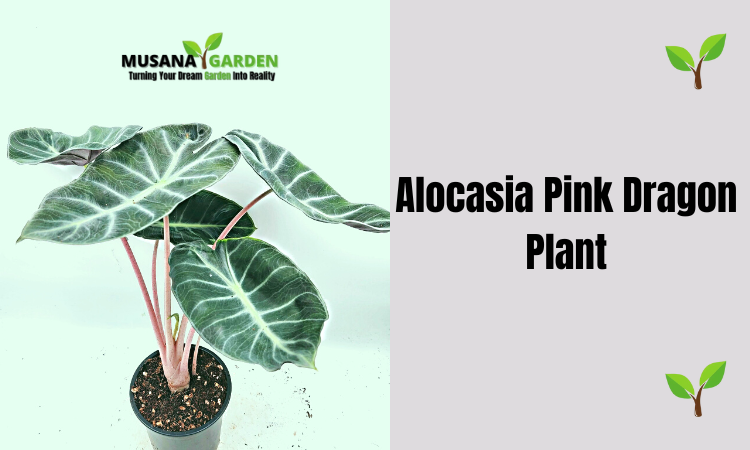
Alocasia Pink Dragon comes from the South Pacific Islands and the Philippines. It is a tropical plant that likes to be wet and in the sun. Large, arrow-shaped leaves with dark green surfaces that are shiny and light green veins grow from the plant’s pink stems. The undersides of the leaves are a beautiful shade of burgundy, and in the right conditions, they can grow up to 20 inches long.
Most of the time, these plants are not bushy; instead, they have one large leaf per stem. Even if all the leaves on an Alocasia Pink Dragon fall off, the plant can still grow new leaves because it grows from a bulb. Pink Dragons love to grow from these small bulbs and can get as tall as 8 to 10 feet. With the right conditions and careful care, these plants can grow quickly and last for many years as a beautiful addition to any home.
8 Quick Caring Guide For Your Alocasia Pink Dragon
Follow these steps to take care of and grow an Alocasia Pink Dragon:
- Put the plant somewhere warm and bright, but not in direct sunlight. Alocasia Pink Dragon likes temperatures between 64 and 86°F (18 and 30°C) and between 60 and 70% humidity.
- To stop root rot, use a potting mix that drains well and a pot with drainage holes.
- Water the plant often, but don’t give it too much water. Before you water again, the soil should be just a little bit dry to the touch.
- Mist the leaves or put a tray of water near the plant to keep the humidity high.
- During the growing season, you should give the plant a balanced fertilizer made for tropical plants every 4 to 6 weeks.
- Pests like spider mites, mealybugs, and scale insects should be watched out for. Check the bottoms of the leaves for small insects or their eggs, and if you find any, use an insecticide.
- Alocasia Pink Dragon can’t handle the cold, so it needs to be grown inside or in a greenhouse. If you live in a warm area and want to grow it outside, put it in a shady spot that is out of the way of strong winds.
- Check the leaves often for signs of yellowing or browning, and change how you care for the plant if you see any.
By doing these things, you can give your Alocasia Pink Dragon the best place to grow and enjoy its beautiful and unique leaves.
How to Identify an Alocasia Pink Dragon
At first glance, it’s easy to tell that the Pink Dragon plant has broad leaves and is in the Alocasia family. It has long, lobed leaves that are a deep green colour and have clear veins. It also has a pink stem that leads to burgundy leaves on the underside.
Each stem, or petiole, grows one leaf, and the veins on the leaves are a light silvery colour. But the Alocasia genus has more than 70 species, and some of them are often mixed up or misidentified because they often breed with each other.
Most species of Alocasia have similar needs and care, but there are some visual differences between species that are often confused that are important to remember when looking for the popular Pink Dragon variety.
Detailed Care for a Pink Dragon Alocasia
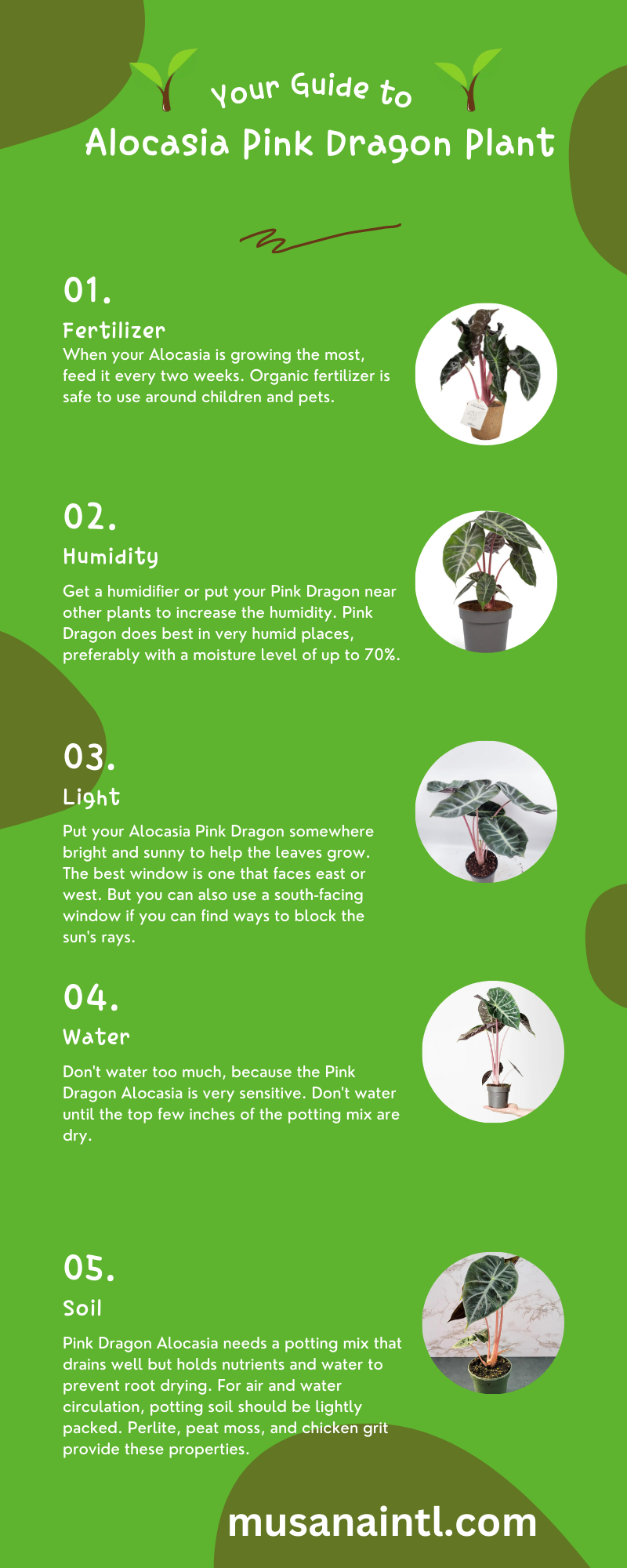
The Pink Dragon Alocasia does best when it is grown in a potting mix that drains quickly, has a lot of air, and is rich. Put it somewhere with a lot of light to help it grow faster. Water the mixture just enough to keep it moist but not soggy, and keep the temperature at 18°C and the humidity at 70%.
Temperature
Choose a place that stays warm most of the time to grow your Pink Dragon. This plant does best when the temperature is between 18 and 30°C (64 and 86°F). Make sure to keep it away from vents and air conditioning units, as strong gusts of hot or cold air can hurt the plant’s leaves.
If you want to know what temperature is best for your Pink Dragon, start by thinking about where it lives in the wild.
Also, Alocasia is a tropical plant, which means it grows best in warm weather. It grows best when the temperature is between 18 and 30°C (64 and 86°F).
Keep it away from vents so it doesn’t get blasted with cold air. Also, don’t put it too close to a window or door, especially if it’s a door or window that gets opened a lot.
It’s best to keep a close eye on your plant so you can tell if it’s being affected by sudden temperature changes. For example, if it starts to droop or lose leaves, you’ll know that you need to change the temperature on your thermostat.
Humidity
Get a humidifier or put your Pink Dragon near other plants to increase the humidity. Pink Dragon does best in very humid places, preferably with a moisture level of up to 70%.
This Alocasia likes high humidity of at least 60%, just like it does in a tropical environment. But try to get to a 70% level if you can.
Think about where you put your houseplant and how that will affect it. For example, many people don’t think about how their plants are affected by things like air conditioners.
The problem is that the moving air that comes out of vents is drying, so it dries out your Alocasia.
Also, this air could cause the cells inside the plant to freeze, which would stop nutrients and water from moving freely. When this happens, the leaves will slowly start to turn yellow, and the plant may eventually die.
Fertilizer
When your Alocasia is growing the most, feed it every two weeks. Organic fertilizer is safe to use around children and pets.
Even though it’s not required, you should feed the Pink Dragon Alocasia, especially when it’s in its growing season.
Find a good fertilizer for houseplants and use it on your plant from spring until late summer. Use half-strength fertilizer once every two weeks to help plants grow faster.
You have two main types of houseplant fertilizers to choose from: those made from chemicals and those made from natural materials. Chemical-based types get the same results, but they often cause too many salts to build up, which can lead to fertilizer burn.
Organic houseplant fertilizer, like Jobe’s Organics All Purpose Fertilizer, is a safer alternative.
It has a mix of natural ingredients like healthy bacteria, archaea, and mycorrhizal fungi. It makes it safe for the environment and for kids and pets to be around.
It’s also well-balanced, so it can give your alocasia the same amount of all the nutrients it needs.
Growth
Set aside a lot of room for your Pink Dragon Alocasia, which can grow up to 4 feet tall. But if its leaves get in the way, don’t be afraid to cut them back to keep the tree’s shape.
The Alocasia Pink Dragon is a kind of houseplant that needs a lot of space.
It can reach a height of 1.2 meters (4 feet) and a width of about 80 cm if the conditions are right.
This makes it a nice plant to put on display inside because of its size. But if you don’t want it to grow too tall or too bushy, you can prune it to the height and width you want.
When it’s fully grown, the Pink Dragon is one of the many pretty plants you can have. It gets its name from the deep veins on its broad leaves, which look like dragon scales.
The undersides of the leaves are an interesting shade of burgundy, while the stems are a beautiful shade of pink.
More Trending Guide:
- Alocasia purple sword Care
- Alocasia wentii Care
- Alocasia Chantrieri Guide
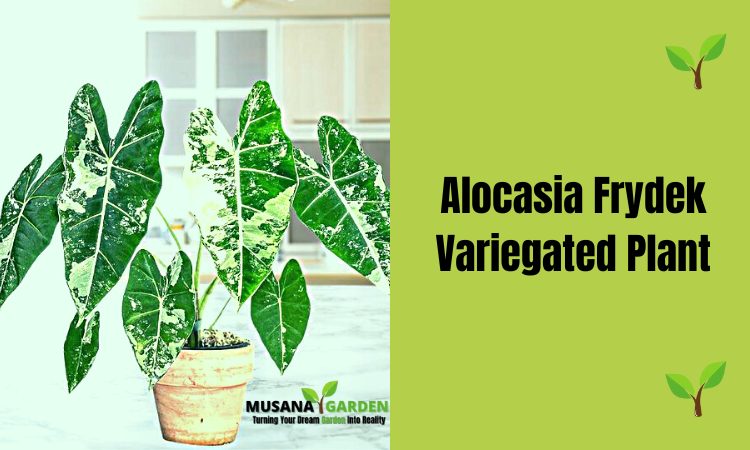
- Alocasia Frydek Variegated Care Guide
- Alocasia Low Rider Care
- Alocasia Dragon’s Breath Care
- Alocasia Dark Star Care
- Alocasia Jacklyn Guide
- Alocasia Yucatan princess Care
- Alocasia Cucullata Guide
Potting Soil
This Alocasia doesn’t mind that it has to stay in a pot. Because of this, you only need to repot a fully grown plant once every year or two. Pink Dragon alocasias that are 6 to 12 months old can be repotted more often.
Some plants do better when their roots are crowded, and the Pink Dragon is one of them. The good news is that you won’t have to move it as often as you do with other houseplants.
This is because it is very sensitive to transplant shock, so you should only repot it when you have to. If your Alocasia is young and growing quickly, you should repot it every six to twelve months. When it gets older, you won’t need to repot it for another year or two.
When a Pink Dragon is fully grown, you only need to change the top one to two inches of its soil every year.
Watch the size of the pot you move your plant to. You don’t want to move it to a pot that’s too big, because that could cause the roots to die.
In the same way, don’t move it until spring or early summer, when it’s growing the most.
Propagation
The best way to spread this Alocasia is by dividing it. Dig around the parent plant and carefully pull out its thick, tuberous roots. Then cut the roots into smaller pieces. If you want to grow more than one of these plants, you can then put each bulb in its container. Water it the right amount, and then put it somewhere bright and sunny.
The Pink Dragon grows from rhizomes, the same way that other alocasias do. Because of this, the easiest way to spread it is to divide its rhizomes. This is how you should do it:
- Find a small shovel and dig around the parent plant with it. A quick tip: If you dig in a circle, you won’t hurt the roots.
- Take your Alocasia carefully out of the soil and cut its bulbs into smaller pieces.
- If you want to move the bulbs to a garden, dig a hole for each one. Make sure the hole is big enough to fit the diameter of the bulb and the length of the root.
- Put your rhizomes in the hole and pat the dirt around them.
- The last step is to move the pot to a warm place and water it as often as you need to keep the soil moist.
Soil Mixture
The best potting mix for Pink Dragon Alocasia is one that drains well but can also hold nutrients and enough water to keep the roots from drying out. The potting soil needs to be loosely packed so that air and water can move through it easily. Add things like perlite, peat moss, or chicken grit to get these qualities.
The Pink Dragon Alocasia does best when it is grown in soil that is porous and drains well. The best potting mix has equal parts of regular potting soil, perlite, and peat moss.
These ingredients help the mixture keep just the right amount of moisture and drain the right amount of excess water. Even though the roots of an alocasia like a little bit of moisture in the soil, they don’t do well in water-logged or very damp places.
To make sure the Pink Dragon grows well, it’s important to choose the right growing medium. If there is a lot of water in the soil, it won’t be long before the tubers start to rot and die.
By mixing in peat moss and perlite, you add the right nutrients to the soil without adding too much water.
I also like to use poultry grit, especially when I can’t get perlite. The tiny rocks and particles in the chicken grit make it easier for water and air to move through the potting mix.
Light Requirements
Put your Alocasia Pink Dragon somewhere bright and sunny to help the leaves grow. The best window is one that faces east or west. But you can also use a south-facing window if you can find ways to block the sun’s rays.
The Pink Dragon does best in a room that is bright and sunny. The leaves with different colours need a good amount of sunlight to grow.
But direct or very strong sunlight is not good because it will burn the leaves.
In this way, an east- or west-facing window is the best place for your Alocasia. You can also use a south-facing window, but you’ll need to take a few steps to protect your plant from direct sunlight. These things are:
- Put up a sheer curtain on the window to filter the light that comes in.
- Putting your Alocasia a few feet from the window. So, it can lie in the sun without getting hit by the sun’s harsh rays.
- Putting up a window film or tilt, which also helps to filter light, is one way to do this.
Watering Needs
Don’t water too much, because the Pink Dragon Alocasia is very sensitive. Don’t water until the top few inches of the potting mix are dry.
When it comes to getting water, the Pink Dragon is a little picky. Before you water, you must make sure that the top 2 to 3 inches of soil are completely dry.
Using this method, you’ll only need to water your plants two to three times a week, and even less in the winter.
If you water a plant more than it needs, it can get sick from fungi. But you don’t want to submerge it because that will make it dry and droopy.
Problems that often happen with Pink Dragon Alocasia

Even though Alocasias are easy to grow, it’s not uncommon for pests and diseases to attack them. Here is a list of the most common bugs and what you can do to get rid of them.
Mealybugs
These tiny, flat, oval-shaped bugs like to feed on the Pink Dragon’s sap. Due to how small they are, they are hard to see with the naked eye. Look for a powdery or cottony white substance on your houseplants. This is a better way to figure out what they are.
Mealybugs can be removed from your Alocasia by dabbing them with a Q-tip that has been dipped in rubbing alcohol. But if you don’t want to go to these lengths, you can also bring in ladybugs and lacewings, which are natural predators.
Spider mites
These spiders are about a millimetre long and come in a variety of colours, including tan, red, and black.
When they eat a plant, they leave a pattern of silvery dots on the leaves. If you look more closely, you can see tiny webs on the undersides of the leaves and in the corners of the stem.
Like mealybugs, these bugs eat the tissues and sap of Alocasia plants. They poke holes in the cell walls of the leaves and drink the sap. If the pests are bad enough, the leaves will start to lose their colour and fall off.
Clean your plant often to keep them from taking over. You’ll also want to make sure you keep the humidity at the right level.
Spider mites like places that are dry, so making the air around your plant more humid is a good way to keep them away.
Bugs with scales
Pests like these are also very common in indoor plants. They look like tiny, egg-shaped bugs with a shell-like cover that is brown to tan. They like to attack the undersides of leaves and the places where leaves join.
If there are only a few scale insects on your Pink Dragon alocasia, you can easily get rid of them by picking them off or dabbing them with rubbing alcohol-soaked cotton swabs.
Get a pesticide of your choice if you have a full-blown infestation. I like to use natural pesticides, like a neem solution I made myself. Usually, this is made with 5 ml of neem oil, 2 ml of soap, and 1 L of water. First, stir the soap into the water. Then, add the neem oil.
Alocasia Ivory Coast vs Pink Dragon
Most of the time, people mistake the Alocasia Ivory Coast for the Pink Dragon. Some of the most important ways to tell these species apart are by the colour and shape of the leaves. Ivory Coast plants have leaves with a slight silvery tint and light green veins that aren’t as clear as those on Pink Dragon plants, which have leaves with a more metallic look and silvery veins. Both of these plants can have pink stems, but the Ivory Coast variety doesn’t have the Pink Dragon variety’s burgundy undersides on its leaves. If you look for these signs at the plant store, you can be sure that the Alocasia you buy is a Pink Dragon.
Alocasia Pink Dragon vs Morocco
There are so many different kinds of Alocasia that it’s hard to keep track. With so many cultivars and hybrids on the market, it is easy to think that Alocasia Pink Dragon and Alocasia Morocco are the same species. But they are the same species, called Alocasia lowii by scientists. It’s common to see the same plant called both Alocasia Morocco and Pink Dragon in articles or plant stores. Both names refer to the same plant, though.
Frequently Asked Question
What is a Pink Dragon Alocasia?
Alocasia Pink Dragon is a type of the Alocasia plant that is known for its big, shiny pink and green leaves. It grows in Southeast Asia and is a tropical plant.
How do I take care of a Pink Alocasia?
To take care of an Alocasia Pink Dragon, keep it in potting mix that drains well and put it in a warm, bright place that isn’t in direct sunlight. You should water it often, but don’t overdo it because the plant can get root rot if you do. Mist the leaves or put a tray of water near the plant to keep the humidity high. During the growing season, use a balanced fertilizer to feed it every 4 to 6 weeks.
How often should my Alocasia Pink Dragon be watered?
When the soil is just a little bit dry to the touch, you should water your Alocasia Pink Dragon. Make sure to water it well, but don’t let the soil get too wet. Aim to water the plant once a week, or more often if the weather is hot and dry.
Can I grow my Pink Dragon Alocasia plant outside?
Alocasia Pink Dragon can’t handle the cold, so it needs to be grown inside or in a greenhouse. If you live in a warm area and want to grow it outside, put it in a shady spot that is out of the way of strong winds.
How do I know what kind of fertilizer to use on my Alocasia Pink Dragon?
Use a fertilizer that is balanced and made for tropical plants. You can use either a liquid fertilizer or a granular fertilizer with a slow release. During the growing season, you should fertilize every 4 to 6 weeks.
What is wrong with my Alocasia Pink Dragon? Its leaves are turning yellow.
Yellow leaves can be caused by many things, like too much or too little water, not enough fertilizer, or pests. Check the soil’s moisture and make sure you aren’t giving the plant too much or too little water. Make sure you give the plant fertilizer often. Check the undersides of the leaves for small insects or eggs if you think there might be pests.
Conclusion
Do you want to try growing plants inside? Pick a plant like Pink Dragon Alocasia that is easy to take care of.
Even though it’s not as picky as some other houseplants, you still need to make sure it gets enough light, gets watered when it needs it, and stays at the right temperature and humidity.
If you do these simple things, this plant will give you beautiful leaves that will change the look of your home.
More Guide
- Philodendron dark lord vs majesty Comparison
- Philodendron Fuzzy Petiole Vs Nangaritense Guide
- Philodendron Melanochrysum Vs Micans Guide
- Philodendron Plowmanii Vs Mamei best comparison Guide
- Philodendron Pedatum Vs Florida Guide
- Philodendron Red Sun Vs Prince Of Orange
- Philodendron Orange Marmalade
- Philodendron Imperial Green
- Philodendron Paraiso Verde Guide
- Philodendron Golden Dragon Guide
- Philodendron Florida Green Guide
- Philodendron silver stripe Care
- philodendron Shangri La Care
- Philodendron Cream Splash Care
- Philodendron Florida Ghost Guide
- Philodendron snowdrift Care