
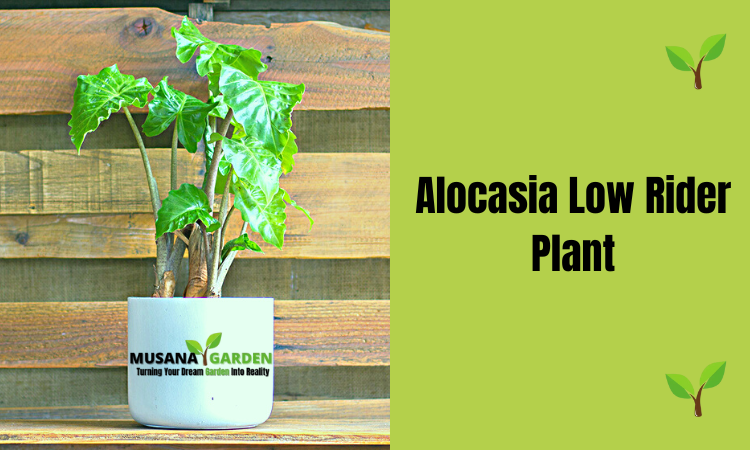
The Alocasia Low Rider is a dwarf type of Alocasia, as its name suggests. Alocasia Zebrina, Alocasia Sarian, and Alocasia Black Velvet are some of the other kinds of Alocasia.
‘Low Rider’ It’s great for people who want a houseplant that will fit in a small space. It goes well with other plants and is valued for its beautiful green leaves.
As with all types of Alocasia, you need to take care of these little beauties in a certain way for them to do well. This care guide for the Alocasia Low Rider comes in handy.
Care for Alocasia Low Rider
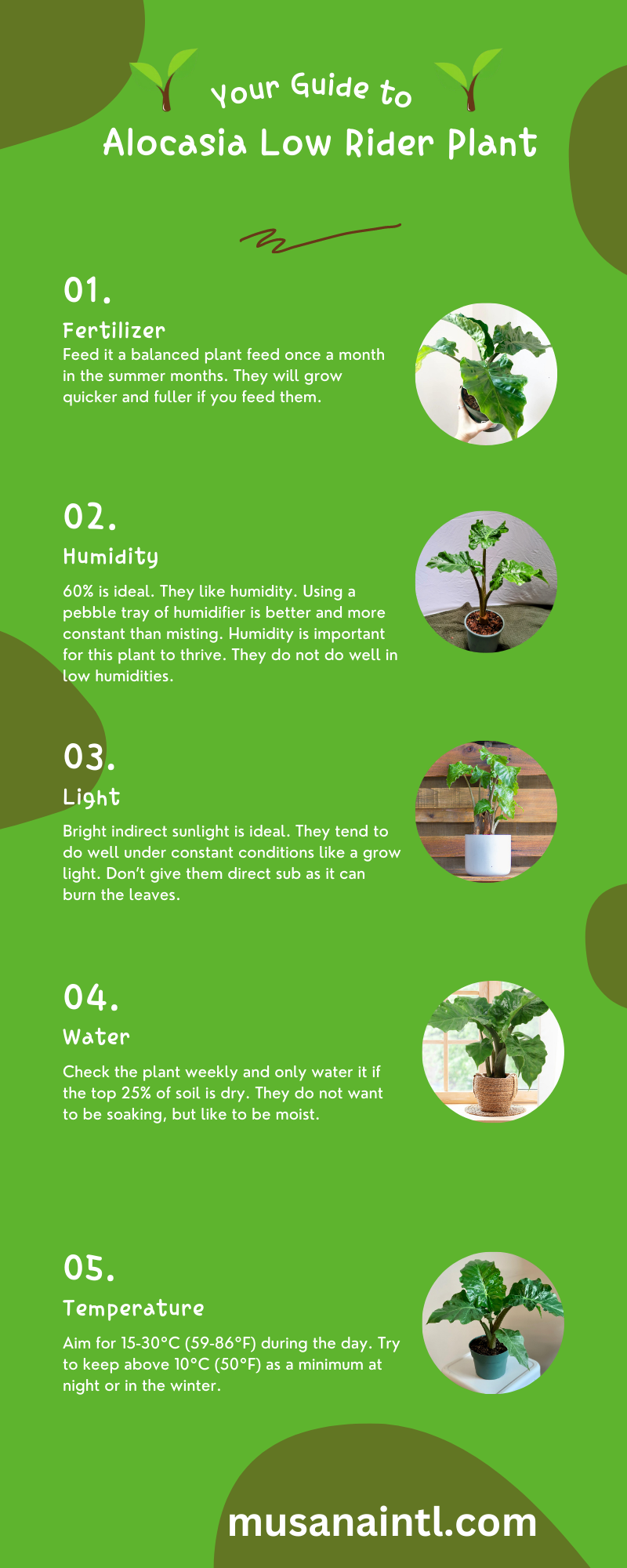
Alocasia Low Rider does well in temperatures between 60 and 70 degrees Fahrenheit (21 degrees Celcius). The “Low Rider” needs bright, indirect sunlight and about 60–70% humidity.
The soil will need to be kept moist all the time, but not too wet or too dry. Make sure to water this regularly so that it stays healthy. The soil will need to be peaty enough to hold water, but it will also need to drain well enough to stop root rot.
Light Needs
The Alocasia Low Rider needs the same amount of light that the Alocasia species gets in the wild.
The best place for them would be under the canopies of the rainforest canopies in Asia, where there is a mix of light and shade.
Having a houseplant makes it a little harder to do that, though. So, the next best thing is to make sure your plant has access to strong but indirect sunlight.
Put it in a room near the windows, but not where the sun’s rays will hit it directly.
Make sure your Alocasia Low Rider is not in direct sunlight, because the beautiful leaves can get sunburned if they are.
Watering Requirements
Watering schedules are just as important as light levels when it comes to making sure your Alocasia Low Rider feels right at home.
The Alocasia plant grows along the banks of rivers in tropical areas. So, the plant will feel most at home in soil that is damp.
At first, it can be hard to get it right, but in general, a regular light watering schedule will make sure that the roots don’t get too much water at once and that the soil always has access to water.
Soil Mixture
We just learned that the soil needs to be kept just a little bit damp. For this, you will need a special mix of standard potting mix with extra peat moss. This will usually do the trick.
Make sure the pot has a few drainage holes so that any extra water can drain out.
Right from the start, you need to make sure that the soil is just right so that the plant doesn’t get a fungal infection like root rot.
Temperature
This tropical plant likes it when it’s warmer. It will be most comfortable between 65 and 75 degrees Fahrenheit (18 and 24 degrees Celsius), but the higher temperatures will be better.
Even if this plant is inside, protect it from very cold temperatures. The plant will go into dormancy if it stays below 60 degrees Fahrenheit for a long time.
Flowers
Don’t buy the Alocasia Low Rider if you want a flowering plant. No, the beautiful leaves of the Alocasia species are what people like most about it.
Other types of Alocasia usually bloom now and then, but this is pretty rare for the “Low Rider.”
People who are interested in Alocasia disagree about whether or not you should let your plant bloom. The reason is that even making one flower can be very hard on the plant, which hurts the leaves.
Because of this, many people like to get rid of the first signs of flowers. But you probably won’t have to worry about it happening to your Low Rider because it’s not very common.
Humidity Level
Since the Alocasia is from the tropics, it shouldn’t be a surprise that the Alocasia Low Rider likes it when it’s humid.
That means that the humidity is over 60%. But the plant will do best when the humidity is closer to 70%.
Depending on where you live, this may be hard for you. Mist the leaves of your Alocasia Low Rider or, if necessary, buy a humidifier to make the air around it more humid.
You can also put your plant in more humid places, like the bathroom or kitchen, where there is a lot of water.
Check Out This Guide
- Alocasia Dark Star Care Guide
- Philodendron Fuzzy Petiole Guide
- Philodendron Jose Buono Care Guide
- Philodendron el choco red Guide
- philodendron summer glory Guide
- Philodendron Lickety Split Care
- Alocasia Jacklyn Care Guide
- Alocasia Dragon’s Breath Care
Repotting
At the end of the dormancy period, when the first signs of spring appear, you might want to check on your Alocasia Low Rider by taking it out of its pot.
Here, you will check to see if the plant needs to be moved into a bigger pot. You should also make sure the roots aren’t crowded, look for signs of root rot, and replace the soil.
Growth
The Alocasia Low Rider is a good plant to have if you don’t have a lot of room. You won’t have to worry about the “Low Rider” taking over the house because it will only grow to be 2 feet tall and 2 feet wide at most.
If you want something bigger or more impressive, the Alocasia ‘Dark Star’ can grow up to 6 feet tall.
Toxicity
Because the stems of the Alocasia plant contain crystals of calcium oxalate, both animals and people can be hurt by it.
If you have animals or children who are always getting into things, you might want to choose a different species or put the plants in a place that is hard to get to.
If you think a child or pet has eaten some part of the plant, watch for signs of a reaction.
This can cause swelling, redness, burning, drooling, and itching around the lips or eyes.
In the worst cases, the reaction can cause the airways to swell, which can make it impossible to breathe. If you think your child or pet might be reacting, get them to a doctor right away.
Propagation
If you try to grow the Alocasia Low Rider from seeds or cuttings, you will be let down. That’s just not a good way to do things.
This plant is mostly spread by separating the underground rhizomes that grow away from the mother plant.
You’ll need to figure out where to split the rhizomes and see if any offsets are growing from the tubers under the soil.
Most of the time, the best time to do this is at the end of winter, just as the plant is coming out of its winter sleep.
Lucky for you (or not, depending on how you look at it), a plant in a pot won’t have room to grow many rhizomes, so you’ll only have a few to divide.
First, take the Alocasia Low Rider that is in a container out of the pot. You can also check at this point to see if the mother plant needs to be repotted. If the roots look crowded or tangled, you’ll know this is the case.
Once you have carefully taken out the mother plant, you can give it a light shake to get rid of any extra soil.
You will quickly be able to see where the base rhizome can be split, and if you’re lucky, you may even find some offshoots.
Use a clean knife or other cutting tool to cut off the rhizome and free any offsets from the mother plant’s roots.
Once you’ve taken them apart, you can plant your new growths. Use a potting mix that will help them grow the best.
You can buy potting soil that is already mixed, or you can mix soil and coco coir. Once the new plants are in the ground, give them a little water and put them in a place where they won’t get direct sunlight.
Problems that often happen with the Alocasia Low Rider

The leaves of the Alocasia plant and its many different types are beautiful and make a beautiful backdrop for any home.
But they can be picky, and it can be hard to make your home feel like a tropical rainforest.
We’ll tell you about some of the most common problems with the Alocasia Low Rider and how to fix them.
Not enough light
If there isn’t enough light, the stems of an Alocasia Low Rider will start to droop. This is how it tries to find more light.
You know you shouldn’t put the plant in direct sunlight, so this one is hard to figure out. Make sure that your Low Rider isn’t the farthest thing from the window in the room and that the light it gets from the window is still bright.
Leaves Turning Yellow
Many things can make the leaves on an Alocasia Low Rider turn yellow. Some easy fixes include making sure the soil is moist enough and the plant is getting enough water.
On the other hand, too much water could be a problem. When temperatures drop below 60 degrees Fahrenheit, plants go to sleep and their leaves turn yellow.
Root Rot and Overwatering
As we’ve seen in this guide, the soil for the Alocasia Low Rider needs to be damp or moist, but not soggy.
A plant won’t be happy if the soil is too wet. The wet environment will eventually reach the leaves and cause them to change colour, as well as rot the roots.
Root rot is the worst thing that can happen when plants get too much water. If the soil is too wet, the roots will get fungal infections. Eventually, the roots won’t be able to absorb water, and the plant will die.
You might find that it pulls away from the ground completely over time, at which point it is too late to fix the problem.
Make sure there is enough drainage, that the soil is damp but not soggy, and that you check the roots for signs of infection every six months.
Leaves that are brown, crispy, and curling
The beautiful look of the Alocasia Low Rider can be hurt by low humidity. If the roots can’t take in enough water to make up for what the leaves lose, the leaves will start to curl in on themselves and dry out.
Check the level of humidity in your home. It should be between 60 and 70%. If not, you might need to get a humidifier or spray the leaves with water.
During the winter, heating systems can cause humidity levels to drop to around 40%. You can help your plant if you move it to a place with more humidity, like where you hang clothes to dry, the bathroom, or the kitchen.
Pests and unwelcome guests
The Alocasia Low Rider is loved by mealy bugs and spider mites. Keep an eye out for any pests you don’t want. These two are likely to show up at some point.
Most of the time, one or two isn’t a big deal, but a lot of them can spread quickly. If you see any visitors, you’ll have to move your plant away from the others and start treating it.
You can get rid of any bugs with a hose or a soapy water rinse. We think you should try this method before you try any other rough solutions.
Questions about Alocasia Low Rider that people often ask
Why are the leaves on my Alocasia Low Rider falling off?
You might be surprised to find that the leaves on your Alocasia are falling off, even if they all fall off over a few weeks. If you just bought your plant or moved it to a new place or soil, this could be a sign that it is stressed and trying to get used to its new surroundings. It could also lose its leaves because it’s going to sleep for the winter or because it’s getting colder. If you follow the rest of the instructions in this guide for taking care of the plant, it will likely come back in the spring.
Why is my Alocasia Low Rider not growing?
The Low Rider is a dwarf version of the Alocasia plant, so it shouldn’t grow any taller than 2 feet. Also, don’t think that the plant will grow during this time.
Is it dangerous for cats?
If cats eat it, it will hurt them. If your pet eats any, talk to a vet right away.
More Guide
- Philodendron dark lord vs majesty Comparison
- Philodendron Fuzzy Petiole Vs Nangaritense Guide
- Philodendron Melanochrysum Vs Micans Guide
- Philodendron Plowmanii Vs Mamei best comparison Guide
- Philodendron Pedatum Vs Florida Guide
- Philodendron Red Sun Vs Prince Of Orange
- Philodendron Orange Marmalade
- Philodendron Imperial Green
- Philodendron Paraiso Verde Guide
- Philodendron Golden Dragon Guide
- Philodendron Florida Green Guide
- Philodendron silver stripe Care
- philodendron Shangri La Care
- Philodendron Cream Splash Care
- Philodendron Florida Ghost Guide
- Philodendron snowdrift Care
- Philodendron Domesticum Care
- snow white waffle plant Care
- Alocasia Jacklyn Caring Guide