
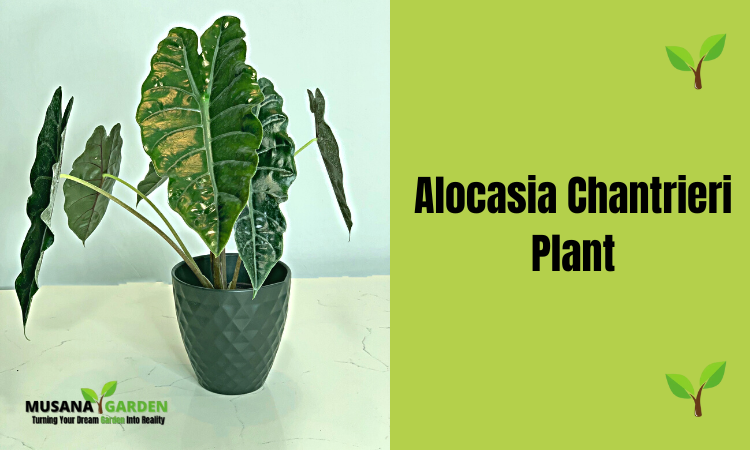
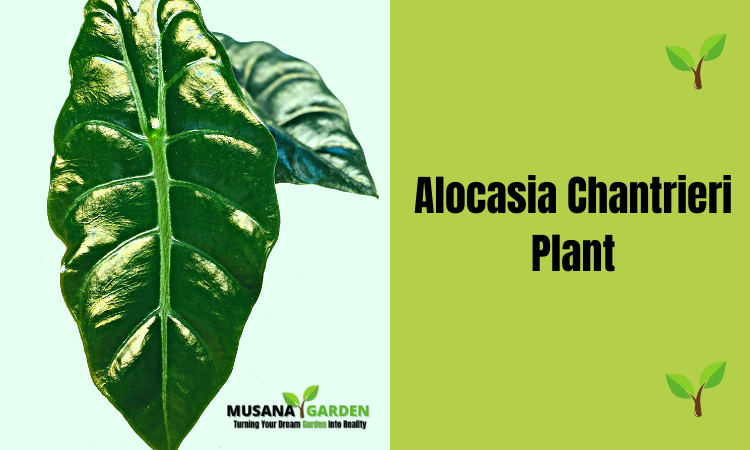
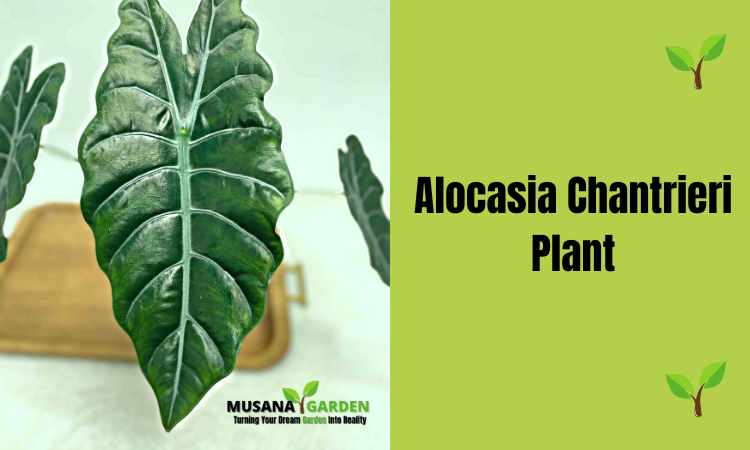
Because of its unique and beautiful looks, the Alocasia Chantrieri is also called the Chantrieri African Mask plant. It is a rare plant that costs at least $250 because it is so hard to find. You might sometimes see it for “only” $150.
The plant has leaves that are a very dark green colour, have wavy edges, and are burgundy on the bottom. When these leaves first come out, they will also look blue.
How do you care for Alocasia Chantrieri? The plant likes bright, indirect light, especially in the morning. Avoid direct sunlight, especially at noon or in the summer.
Keep the temperature and humidity above 50%. Between waterings, let the top 25% of the soil dry out, and use soil that drains well.
The plant makes people, cats, and dogs sick.
Care for an Alocasia Chantrieri Plant

Light Requirements
Alocasia Chantrieri likes indirect light that is medium to bright. It will grow best if it gets a lot of direct morning sun for a long time. So, the best place is near a window that faces east.
On the other hand, stay away from bright light.
This means you should keep it out of the sun during the middle of the day, especially between 10:30 a.m. and 3:30 p.m., when the sun is at its strongest.
If you don’t move it, the leaves will change colour over time. Worse yet, they can get a sunburn, which can leave brown or black marks on the leaves.
This also means you should stay out of the sun in the summer when it is the hottest.
Because of this, it’s a good idea to be careful when putting it in the south or west. During the middle of the day, the sun shines on both of these sides.
So, you want to put the plant far enough away so that the sun’s rays never hit the leaves of the Alocasia Chantrieri.
You could also block out some of the suns by putting up blinds or curtains.
Along with putting the plant in the right place, you should turn it so that all of its sides get the same amount of light. So, the plant grows in an even way and doesn’t lean in one direction.
Every time I water the plant, I like to turn the pot 90 degrees. In the long run, this will make things fair for everyone.
Outside, keep the plant out of direct sunlight. Instead, put it where it will get some shade.
Lastly, if your home doesn’t get much natural light, you can add artificial lights or use them on their own.
Even if your house doesn’t have many windows, this will help the plant grow well.
Watering Requirements
When it comes to watering, Alocasia Chantrieri doesn’t like either too much or too little. This means that it doesn’t like soil that is either too wet or too dry. Instead, it likes soil that stays moist all the time.
This can make it a little hard because if you add too much water, the plant could get too much water and die from root rot.
So, it’s best to keep things a bit on the dry side, but not so dry that the soil dries out.
The best way to do this is to wait to add water until the top 2 inches of soil are dry to the touch. You can also wait until about 30% of the topsoil is dry. Any level in between these two will do.
You don’t have to be exact this way. You also don’t need to worry that you forgot to water for a day or two.
If you let the soil dry out a little between waterings, you won’t overwater at all. Keeping the plant moist at the same time.
Also, you need to know when to water. Also, you should know how to water.
And the best way to water an Alocasia Chantrieri plant is to soak the soil and then let it drain completely.
You can do this by adding water to the soil until it starts dripping out of the bottom of the pot. This means that there is a lot of water in the soil.
Then, let all the water drain out of the soil right away.
Depending on how big the plant is, this second step can take anywhere from 12 to 30 minutes. So, I just put it on a stand in the sink so it can continue to drip.
Both steps are important if you want to give the plant the water it needs.
The first step is to make sure the roots get enough water. This keeps them from getting thirsty. In the meantime, the second step makes sure that the roots don’t stay underwater for too long.
So, what you’re left with is moist soil that lets the roots get enough air to breathe.
Fertilizer Needs
Feed the Alocasia Chantrieri once a month during its growing season for the best growth (spring and summer). You can use a balanced fertilizer with an N-P-K ratio of 20-20-20 or 15-15-15 and dilute it to half the recommended strength.
Stop giving them food at the end of August or the start of September. Don’t give the plant any food in the winter.
This will give the plant everything it needs to grow faster, make more leaves, and make them bigger.
Don’t give the plant too much food or too much fertilizer when it doesn’t need it.
Too much fertilizer can burn the roots of a plant. As a result, this can harm the plant in a way that can’t be fixed.
Once the roots are hurt, the plant won’t be able to get as much water and food from the soil. More importantly, if too many roots are damaged, the plant won’t be able to support itself when there are only a few roots
Check Out This Trending Guide Below
- Philodendron Strawberry Shake plant Guide
- philodendron painted lady plant Guide
- Philodendron Ring of Fire Plant Guide
- Philodendron Blizzard Plant Guide
- Philodendron Golden Violin Guide
- Philodendron Ceylon Beauty Guide
- Philodendron Golden Crocodile Guide
- Philodendron Whipple Way Guide
- Philodendron Caramel Marble vs Ring of Fire Guide
- Philodendron Fuzzy Petiole Guide
- Philodendron Jose Buono Care Guide
- Philodendron el choco red Guide
- philodendron summer glory Guide
- Philodendron Lickety Split Care
Potting Soil
When you use the right potting soil, excess water can drain quickly. So, it is important not to water too much or let the soil get too wet.
And the best soil for Alocasia Chantrieri is a loose one, that drains well, and has a lot of air in it. It also likes soil with a pH between 6.1 and 6.5 and a lot of organic matter.
This is a simple way to put it together:
- 1 part potting soil
- 1 part perlite
- 1 part peat
Fits the plant just right.
The potting soil and peat will help keep the soil moist by holding onto water. There is also some organic matter in pests.
On the other hand, perlite lets soil drain quickly and breathe well.
Heavy or dense soils should be avoided. The same goes for soil that gets packed down.
Lastly, don’t forget to make sure the pot you’re using has a drain.
So, any extra water that comes out of the soil can run out of the pot.
Pruning
The Alocasia Chantrieri will grow big leaves that point outward at a slight angle. They stand up because of their long, thin stems that bend outward.
This makes the plant look beautiful because you can see all of its beautiful leaves.
Even better, the plant often sends out new shoots, which lets it form a tight cluster. This gives the plant a bushy look because there are a lot of leaves on it.
But it is generally easy to take care of and doesn’t need much pruning.
If you think the plant’s leaves are too close together, you can cut some of them off. In the same way, you can cut back the plant to make it grow more.
But after that, most of the pruning will involve taking off any leaves that are dying, old, damaged, or a different colour.
How to Propagate Alocasia Chantrieri
Most Alocasia Chantrieri plants are propagated by dividing them. That’s because taking stem cuttings isn’t a good way to do it.
The plant grows from roots called rhizomes. So, if you dig up its roots, you’ll find clumps of roots that grow from them.
By dividing the plant, you get plants that are already about half grown. This means that, unlike with stem cuttings, you don’t have to wait for the roots to grow on the new plant because they are already there.
The plant will just keep growing.
Here is a step-by-step guide on how to propagate Alocasia Chantrieri by dividing it.
- Take the plant out of its pot as a first step.
- Brush away the dirt so you can see the roots.
- You’ll see stems and leaves, as well as rhizomes with roots.
- Now you can choose how many plants you want to grow from the mother plant. And how you want to split the plant up. The only thing you need to remember is to give each piece enough roots and at least a few leaves. So, the roots can hold up the plant above them. And you don’t start with a plant that has no leaves.
- Use a clean knife to cut out the areas you’ve chosen. You can split the plant into two or more parts, depending on how big it is and how many new plants you want.
- After you split them, put each new plant in its pot and fill it with soil that drains well.
All done.
You now have two or smaller plants that are almost fully grown and will send out new stems and leaves.
Over time, they will grow and look just like the original plant.
Humidity Requirements
The Alocasia Chantrieri likes it when it’s humid. It likes 60% to 70% humidity, but it doesn’t mind even higher levels. It can also work at about 50% or a little bit below that.
But once the humidity drops below 50%, you should watch how the plant reacts.
If the tips and leaves start to turn brown or get crispy, that means it’s having trouble with that level of humidity.
As long as the plant’s leaves don’t dry out or get brittle, it can still survive in that situation.
The good news is that there are a few ways to make the air around the plant moister.
You can buy a humidifier if you have the money for it. But if you don’t want to spend more money, there are also a few free things you can do to increase humidity.
A humidity tray, which is just a tray you fill with water, is something I like to use.
Then, put some rocks in so that the tops of the rocks are higher than the water. The last step is to put the plant on the rocks.
As the water in the tray evaporates, it makes the air around the plant feel more humid.
The rocks lift the pot out of the water so the soil doesn’t get wet.
The only thing you have to do here is put more liquid in the tray when it runs out.
You can also try the following:
- By spraying the plant
- Taking it to the bathroom
- Every two weeks, you should shower the plant.
- Put your alocasia with your other indoor plants.
Temperature
The Alocasia Chantrieri grows best when it’s warm outside. Like other types of alocasia, this plant comes from the tropical and subtropical parts of Asia and Eastern Australia.
Because of this, it likes to be between 65 and 75 degrees Fahrenheit. Also, it doesn’t like temperatures lower than 60 degrees.
This means that the plant needs to be kept in a warm place inside.
If you live in USDA Hardiness Zones 9 to 11, which are always warm and sunny, you can leave it outside in a pot or plant it in the ground.
If not, it is best to make sure to bring the Alocasia Chantrieri inside when the weather gets colder at the end of the year.
If the plant is left outside, it will struggle and eventually die back into the ground.
Still, the tubers will be fine when they are buried. So, when spring comes and the weather gets warmer, the plant will come back to life.
But it will have to start growing again and send out shoots before the leaves appear.
How to Repot or Move an Alocasia Chantrieri to a New Pot
When the Alocasia Chantrieri grows too big for its pot, it will need to be repotted. This takes about 2 years to happen, though.
So, you don’t need to worry about doing it every once in a while.
You shouldn’t repot plants if you don’t have to.
This is because the plant likes to be in a pot that isn’t too big. It also doesn’t like being moved around. And moving plants around can sometimes be a shock or cause stress.
So, don’t do anything until you see roots coming out of the holes in the bottom of the pot.
And if you want a bigger one, choose one that is only one size bigger (around 2 inches more). Don’t overpot, because that will make it more likely that you’ll overwater.
Spring to early summer is the best time to repot.
Is it poisonous or toxic to people, cats, and dogs?
The plant is dangerous, yes. It has crystals of calcium oxalate, which are poisonous if eaten by people or animals.
So, don’t leave small children, cats, or dogs alone near the plant because they might chew on or eat parts of it. If they do, you should call your child’s doctor or the vet right away.
How to fix problems with Alocasia Chantrieri
Diseases
Most of your problems will come from root rot and leaf infections.
Both are caused by having too much water. So, pay attention to how and when you water.
Root rot happens when the soil gets too much water or stays wet for too long. On the other hand, bacterial or fungal infections can lead to leaf diseases.
Second, don’t let the leaves get wet. Don’t water the plant in the evening. Make sure it gets enough light and airflow, which will help the leaves dry more quickly.
Pests
There aren’t many pests that bother the Alocasia Chantrieri. But the plant is liked by mealybugs, spider mites, aphids, and scale.
They will attack the plant as soon as they see that it is weak, sick, or stressed.
So, make sure the plant stays as healthy as you can. And clean its leaves, since dust is a draw for these bugs.
It is also important to be able to find these bugs when there are only a few of them. And treat the plant right away if you find any bugs or other pests.
This is because these species tend to have a lot of young ones.
You can get rid of these bugs with neem oil or insecticidal soap spray.
More Guide
- Philodendron dark lord vs majesty Comparison
- Philodendron Fuzzy Petiole Vs Nangaritense Guide
- Philodendron Melanochrysum Vs Micans Guide
- Philodendron Plowmanii Vs Mamei best comparison Guide
- Philodendron Pedatum Vs Florida Guide
- Philodendron Red Sun Vs Prince Of Orange
- Philodendron Orange Marmalade
- Philodendron Imperial Green
- Philodendron Paraiso Verde Guide
- Philodendron Golden Dragon Guide
- Philodendron Florida Green Guide
- Philodendron silver stripe Care
- philodendron Shangri La Care
- Philodendron Cream Splash Care
- Philodendron Florida Ghost Guide
- Philodendron snowdrift Care